Do we design to work or to look good?

Form vs. function in modern architecture.
Is it still a dichotomy today?
In order to understand how we arrived at this question, it is necessary to briefly discuss two key currents: functionalism and deconstructivism .
As a graduate of a faculty where functionalism was the basis of our training as architects—mainly through the theory of architect José Villagrán García—we learned that this movement, known as Mexican functionalism , developed between 1920 and 1950.
It emerged as an adaptation of two European movements: German modernism and French rationalism , integrated with a Mexican approach, that is, considering the social, cultural and climatic context of the country.
Functionalism is based on the principle that "form follows function," or as my teachers used to say, "If it's a library, it should look like a library." This approach also reflects, in many cases, the economic conditions in Mexico at the time. Don't you think so?
This thinking was interpreted and applied with a social focus: satisfying collective needs, using local materials and efficient construction systems, and adapting to the physical and cultural environment.
Outstanding works of Mexican functionalism:
Popotla Sanitary Farm (1925)
National Institute of Cardiology (1936–1937)
Costa Rica Primary School (1946)
University City, UNAM (1950)
Worker housing (1940s): the first attempt at social housing—an idea that, unfortunately, hasn't changed much to this day. But that's another story...
There are also current examples of architecture with a functionalist approach:
Klinikum Klagenfurt , Austria (2010)
Social Housing in Paris , by Lacaton & Vassal (2000–2020)
Amazon logistics centers , among others.


The other extreme: deconstructivism
Deconstructivism emerged in the 1980s, influenced by the philosophy of Frenchman Jacques Derrida . Although it originated as a philosophical movement, its influence also extended to architecture, art, law, and psychoanalysis.
Architects such as Peter Eisenman and Zaha Hadid explored how architectural form can be deconstructed —that is, fragmented, symmetry disrupted, spatial hierarchies challenged, and the relationship between form and function reconsidered. But here a new element enters the picture: meaning .
Deconstructivism rejects the idea that design should be orderly or predictable, and instead proposes a more ambiguous, fluid, and complex spatial experience. In this movement, form is no longer subordinate to function , but rather dominates it. Function becomes ambiguous, secondary, or reinterpreted.
Outstanding works of deconstructivism:
Guggenheim Museum , Bilbao (1997)
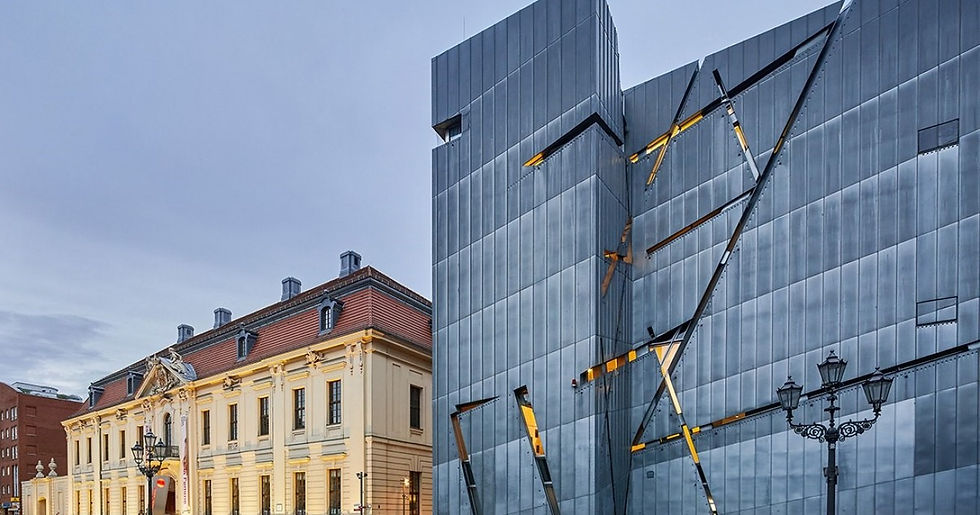
Jewish Museum , Berlin (1999)
MAXXI – National Museum of 21st Century Arts , Rome (2009)
Lou Ruvo Center for Brain Health , Las Vegas (2010)



Conclusion:
In conclusion, form and function are not irreconcilable opposites, but rather complementary dimensions of all architectural work. Throughout history—from Mexican functionalism to the most radical deconstructivism—the two concepts have coexisted, interacted, and evolved according to the context.
The phrase "if it's a library, it should look like a library" reflects a simplified view that overlooks something fundamental: architecture not only responds to what it should be, but also to how it can be . In a changing world, structural, technological, and cultural challenges require us to go beyond dichotomies and seek more complex syntheses.
So… do we continue designing to work, or to look good? Perhaps the best architecture is the one that manages to do both without asking permission.


Comments